
THE COMPLETE DESTINATION GUIDE
Discover Anuradhapura
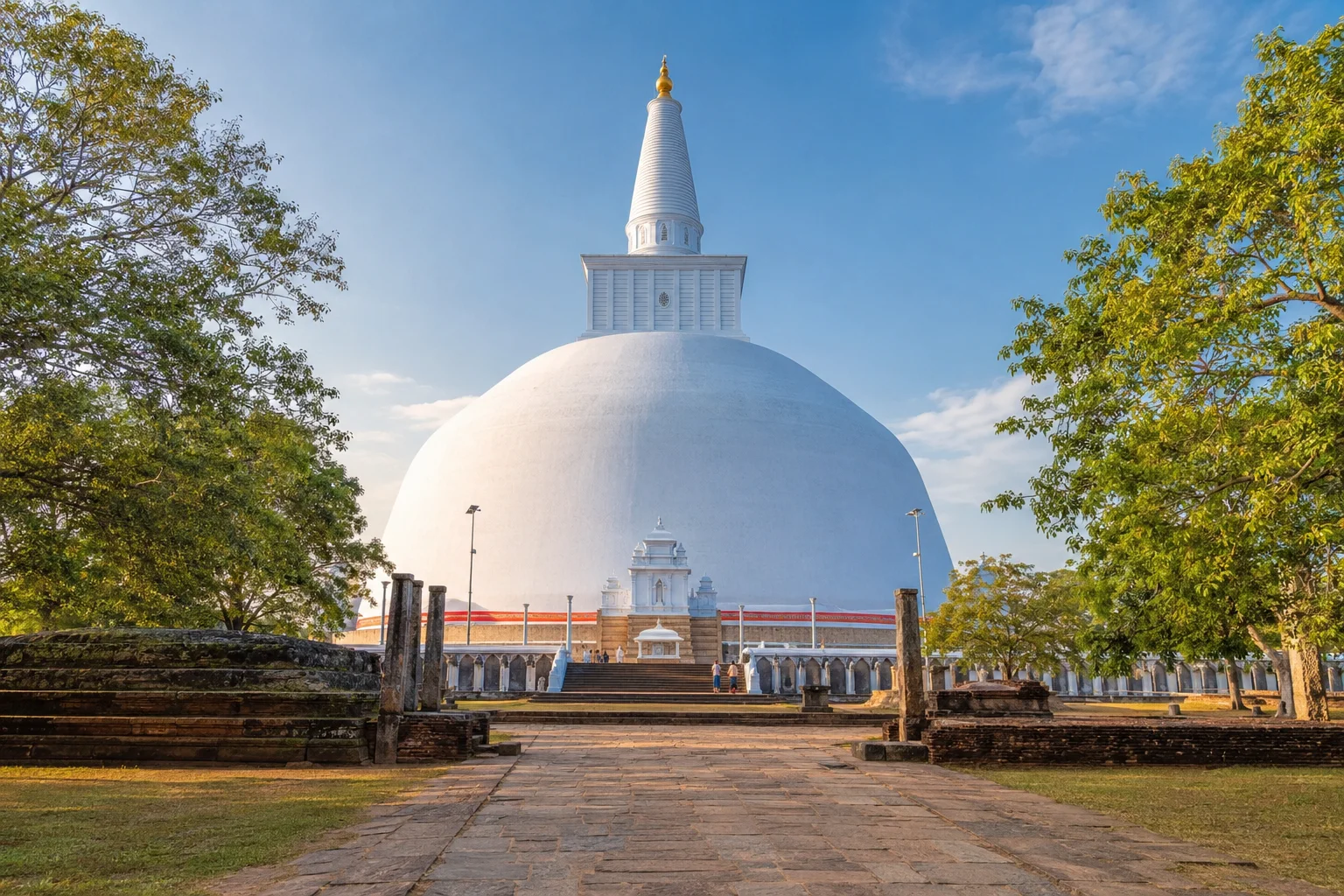
Anuradhapura was the political and religious centre of Sri Lanka for well over a thousand years, and the scale of what survives reflects that long history. Rather than a single compact site, it spreads across a broad, largely flat landscape of lawns, reservoirs and shade trees, connecting enormous brick dagobas (stupas), the remains of monasteries, ceremonial pools, and carved stone platforms once used for public assembly. Several of the dagobas rank among the largest brick structures built anywhere in the pre-modern world, and seeing their scale in person — often best appreciated from some distance away — is one of the site's genuine highlights.
At the heart of the sacred area stands the Sri Maha Bodhi, a fig tree said to have grown from a cutting of the tree under which the Buddha attained enlightenment, and tended by an unbroken line of guardians for over two thousand years. It remains an active site of pilgrimage, with a steady flow of white-clad worshippers year-round, and this living religious practice sits alongside the archaeological remains rather than being separate from them.
Because the ruins are spread across a wide area, most visitors explore Anuradhapura by bicycle, tuk-tuk or car rather than entirely on foot, moving between clusters of monuments connected by quiet, tree-lined roads. A full day allows time to take in the main dagobas, the moonstones and guardstones carved at several entranceways, and the quieter monastic ruins away from the main circuit; a more relaxed two-day visit suits travellers who want to linger rather than cover the site at pace.
As with any active religious site, modest dress and respectful behaviour are expected around the sacred areas, and this is worth planning for before arrival rather than on the day.