
THE COMPLETE DESTINATION GUIDE
Discover Polonnaruwa
Polonnaruwa succeeded Anuradhapura as Sri Lanka's capital, and its ruins feel notably more compact and legible as a result — a genuine ancient city that can be explored in a single, well-organised day rather than requiring the wider wandering that Anuradhapura's scattered remains call for. The Quadrangle, a raised terrace holding a tight cluster of monuments, is often the highlight: temples, image houses and a distinctive circular relic house stand close together, many still carrying fine stone and stucco decoration.
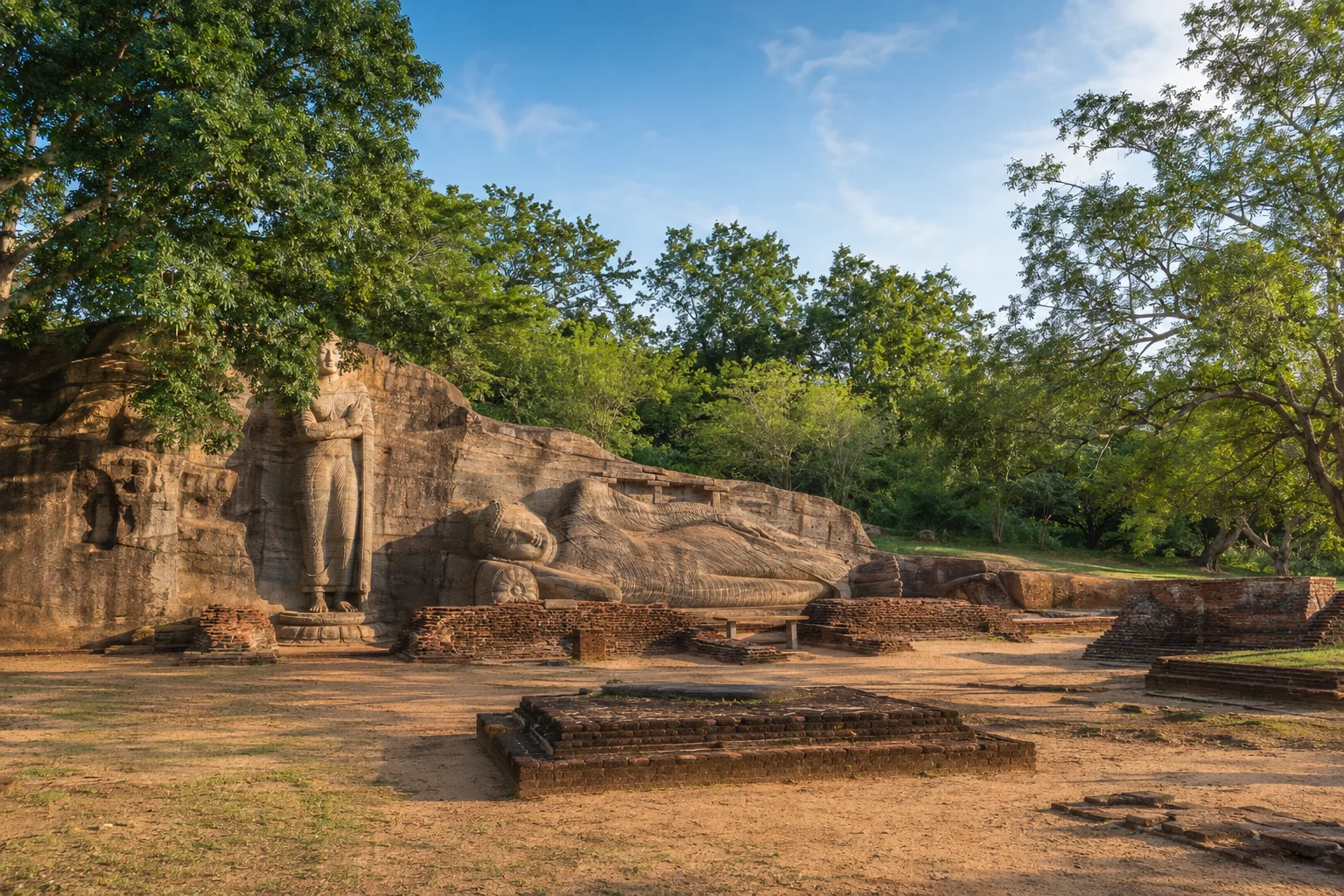
A short distance away, the Gal Vihara holds four Buddha images cut directly into a single long granite outcrop — standing, seated and reclining figures carved with real technical confidence, and among the most admired stone sculpture surviving from this period anywhere in Sri Lanka. Elsewhere across the site, the ruins of King Parakramabahu's palace, a former royal bathing pool, and the earthworks of the vast Parakrama Samudra reservoir all speak to a capital that combined religious, royal and engineering ambition.
Like Anuradhapura, Polonnaruwa is best explored by bicycle or tuk-tuk, since the ruins are spread across a flat, shaded landscape that rewards unhurried movement between clusters of monuments rather than a rushed itinerary. A site museum near the entrance provides useful context on the layout and history of the city before setting out. The surrounding countryside, dotted with reservoirs and paddy fields, also supports a noticeable population of birds and the occasional monkey troop moving through the ruins themselves, which adds an unplanned but genuine wildlife element to an otherwise cultural day out.
Polonnaruwa pairs naturally with a safari at nearby Minneriya or Kaudulla, and many travellers combine the two into a single, satisfying day trip from the Sigiriya or Habarana area.